
From the Sweet 16 to the Elite 8: A Full Weekend of East Regional Madness in D.C.
March Madness fully engulfed Washington, D.C., this past weekend.
The East Regional captivated basketball fans with some of the tournament's best games, highlighted by UConn’s Braylon Mullins, who threw up a dart from the logo to secure the Huskies’ place in the Final Four, with one of the most iconic NCAA Tournament game-winning shots of all time.
To get to the biggest moment of the weekend, let's first review some major stories. We’ll also look back at the matchups between some of basketball's biggest brand names.
DMV Hoopers Return Home
Despite no local teams advancing to the Sweet 16, the area had plenty of individual players making the trip.
With all of the cool stories, I was able to talk to Cam Ward and Jordan Scott during Michigan State’s media availability before the Sweet 16.
Cam, a Team Durant AAU and Largo (Md.) high school product, spoke with me about the “family” culture of the organization and shouted out coach Wayne Pratt, Kevin Durant’s father, who is active in growing and developing the athletes within the organization, which is seen as one of the most successful in the country.
With Jordan, his homecoming was special with his basketball-playing pedigree. His entire family is full of hoopers, and his mother, Christy Winters-Scott, is a former Maryland player and household name in the media.
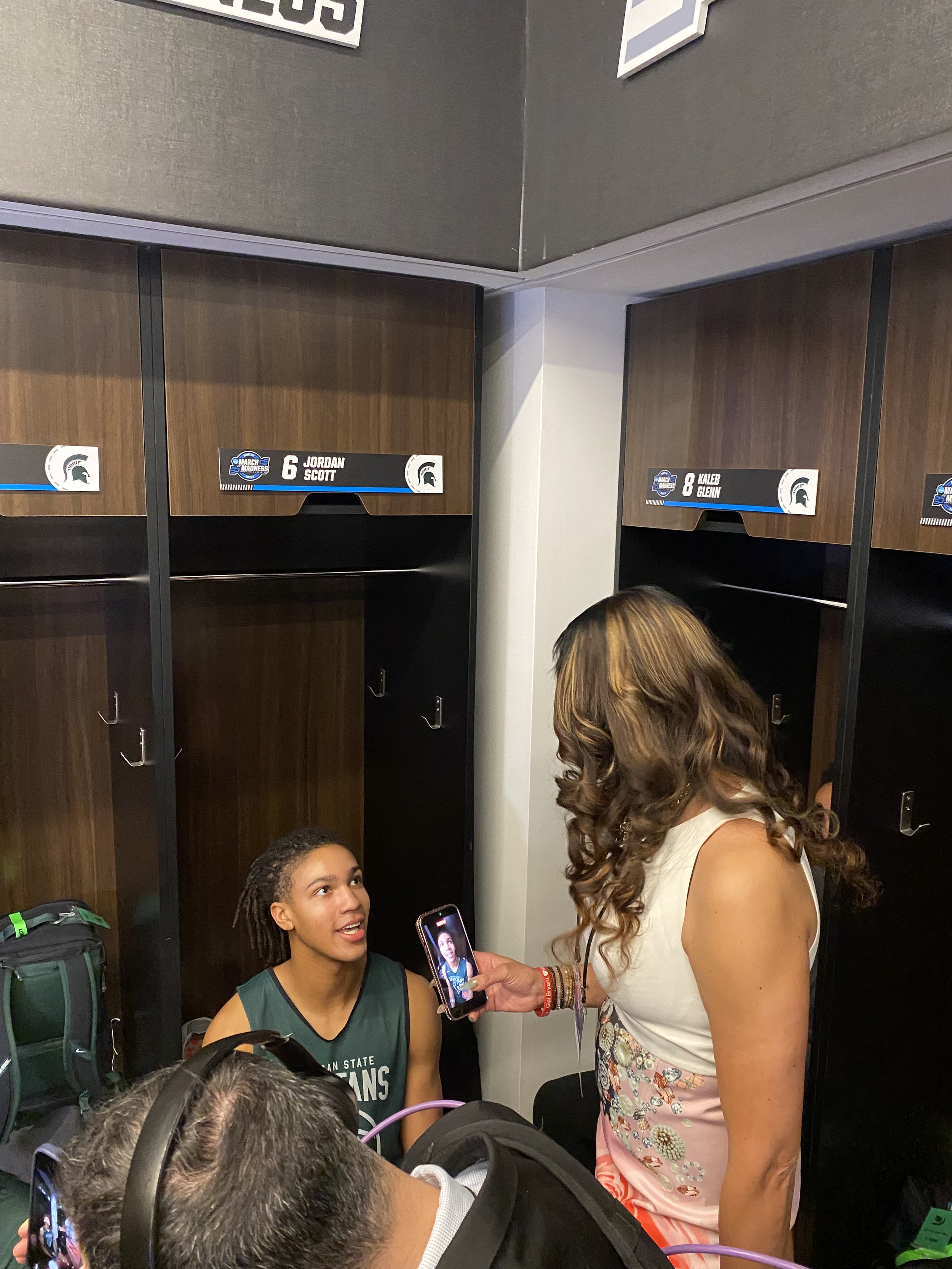
Jordan Scott, interviewed by his mother, Christy Winters-Scott.
In one of the coolest moments of March Madness coverage for me, I got to witness Jordan Scott’s interview with his mom, and I also asked him if any part of his game was inspired by his siblings, particularly his sister Brianna Scott, whom I covered this season at Georgetown.
“Definitely our fiery competitiveness,” Jordan said as to what aspects of his game he gained from his siblings. He then added that, as the youngest, his siblings were always “bigger and stronger” than him, but they “aren’t able to guard” him anymore.
Jordan and Cam were both rotation pieces in Michigan State’s run, and both could prove to be key pieces in the future as the Spartans regroup after falling short in the Sweet 16 this season.
Despite the celebration of talent on the floor, it would be nice to see local teams make consistent deep runs with local talent, but we also need to appreciate the local teams that made the tournament, like Howard men’s and women’s basketball teams, and the consistency of the Maryland women’s program that lives in the NCAA Tournament.
Sweet 16.
Friday set the tone for a strong regional as St. John’s, led by Rick Pitino, took on Duke in the first game of the day.
A strong sea of red took over Capital One Arena as the Red Storm traveled into familiar waters in Big East basketball land in DC, home of the Georgetown Hoyas, looking to upset the Blue Devils.
Heading into the game, I knew that St. John’s would compete with their press and ball pressure, so I asked Coach Pitino about getting the right guys to run his system.
“It all depends on the makeup of your team. Today, it changes year to year more than at any other time. There's no continuity behind most of the teams. It's just a matter of recruiting the people that fit a certain style,” Coach Pitino said.
And that system of getting the right players to play his style worked to slow down Duke, but it was St. John’s three-point shooting (13-of-32), highlighted by a four-for-four three-point shooting night from Reuben Prey, that gave the Red Storm a 10-point lead with 15:01 left in the second half.
However, Duke’s Isaiah Evans’ timely shot making en route to a game-high 25 points, and Cameron Boozer’s bruising play style proved to be too much for St. John’s as they fell 80-75.
In the second game, we saw UConn dominate Michigan State in the first half, cede a comeback that allowed the Spartans to take the lead 47-46 with 9:22 left in the game, and then close out the game physically and efficiently.
UConn received an efficient game from Alex Karaban, one of the most decorated winners in college basketball, Solo Ball, and Tarris Reed Jr., who continued his tear as the East Region’s Most Outstanding Player with another 20-point game in UConn’s 67-63 win.
An action-packed Friday night set the stage for a historic matchup between Duke and UConn.
Elite 8.
On Sunday, the electricity continued as UConn and Duke faced off.
Initially, it looked like Duke would walk away with the game, as the Blue Devils brought the clamps, highlighted by Dame Sarr’s work on UConn’s Alex Karaban.
Sarr’s defense on Karaban stifled the shooter into a 2-for-10 performance from the field on the night.
Duke, led by Cam and Cayden Boozer, held a 44-29 lead at halftime as they worked to bring UConn’s size out on the perimeter using Cam’s playmaking ability, which worked to clear Tarris Reed Jr. out of the paint.
The Blue Devils also utilized big man Patrick Ngongba II, a local Paul VI hooper, to match Reed’s size in the paint defensively, allowing Cam Boozer to be more of a help defender on Reed, a task that slowed down UConn for stretches in the first half.
However, in the second half, UConn adjusted. Reed added postgame that it took “trusting the guys around me, calling out ball screens, left, right. Really playing team defense and helping each other out and stopping the ball” to slow down Cam Boozer.
Despite Cam Boozer shooting 6-for-10 in the second half, many of his playmaking chances were limited, and Duke struggled to get secondary scorers going as they did in the first half.
All of the adjustments culminated in UConn storming back, trailing by four with 1:31 left in the game.
Then, with 50 seconds left, Alex Karaban hit his second field goal of the game to cut the Duke lead to one, then Cam Boozer got in the lane to push the lead back to three.
Next was a Duke foul on Silas Demary Jr., who went 1-for-2 at the line and set the scene for Duke to break a press with 10 seconds left in order to head to the Final Four.
What ensued next will live in March Madness history and Duke infamy for as long as the game is played.
Starting with a Dame Sarr inbound, the ball went to Cam Boozer, who stumbled as he gained possession, allowing a UConn trap. He made a smart decision to get the ball back to his safety valve in Sarr, who then got the ball to the middle of the press to an open Cayden Boozer, who was staring down Silas Demary Jr. and Braylon Mullins with just under six seconds to go in the game.
At this point, both teams accomplished what they wanted. For UConn, they got the ball out of Cam Boozer’s hands, and despite Cayden playing well in the first half, he struggled in the second.
For Duke, they got the ball to the middle of the court, and when the defense blitzed, Cayden took a dribble and picked it up, then attempted a pass to one of the two Duke players on the other side of the court.
Sounds good, except the high pass over Silas Demary Jr. was tipped, and the ball seemingly floated in the air for an eternity until Mullins retrieved it, passed to Alex Karaban, who, as he mentioned in the postgame presser, saw a tougher shot to take with Boozer guarding him and passed the ball back to Mullins.
When Mullins, who later told media he thought his shot was to tie the game, pulled from 35 feet, the air seemed to escape the building, and the volume got so low, you could hear a pin drop as the ball rotated for seemingly eons until dropping into the net, in a fashion similar to a coin plopping into a wishing well, as UConn’s Final Four dreams became reality and the crowd at Capital One Arena shook D.C. with a roar.
UConn defended one last pass from Duke, and as the celebration ensued, a debate ignited across the country about what should have been done with the ball in Cayden Boozer’s hands.
Personally, Duke’s press break worked correctly. They cleanly got the ball to the middle of the floor and even had all five of UConn’s players on the same side of the court when they inbounded the ball.
UConn didn’t leave a basketball-press version of a “free safety” back to handle any passes to the other side of the court when Mullins and Demary Jr. jumped Cayden Boozer, and the Huskies neglected to foul on the catch.
A successful pass to a Duke player with under six seconds left essentially ends the game.
Holding the ball invites UConn to foul, sending Boozer to the line for two free throws. This is what plenty of people think should have happened, but hindsight is 20/20. I’m in the camp that feels this way of thinking overlooks a tremendous defensive play by Silas Demary Jr.
Boozer made a decision that would’ve ended the game, and Silas made a play so good that it helped alter the way we look at March Madness for years to come.
Overall, it was an exciting end to the East Region of the tournament in D.C., and even more fun that the winner was a team I covered during the first two rounds in Philadelphia (more content coming from Philly).
Make sure to share and engage with District of Buckets content across all platforms, as basketball never stops, and we work to cover it all through the lens of a D.C. hoop fanatic
